Layout tab > Devices group >  Symbols menu > Save user
symbol Symbols menu > Save user
symbol |
Layout tab > 3D and view group >  3D functions menu > 3D functions menu >  3D symbol functions menu > Save user 3D symbol 3D symbol functions menu > Save user 3D symbol |
With this function, you can create and save your own symbols.
If you only want to add attributes to an existing symbol or do some simple edits to the symbol graphics, for example, you do not need to explode the symbols before using these save function. However, if you want to use all CADMATIC drawing functions when editing the graphics, you need to explode the symbols into basic elements and edit symbol graphics before using the save function.
Do the following:
-
Select objects to include in symbol to be saved. Alternatively, press Enter to select the symbol from the menu.
-
If selected objects did not include ID attribute, indicate insertion point for it.
-
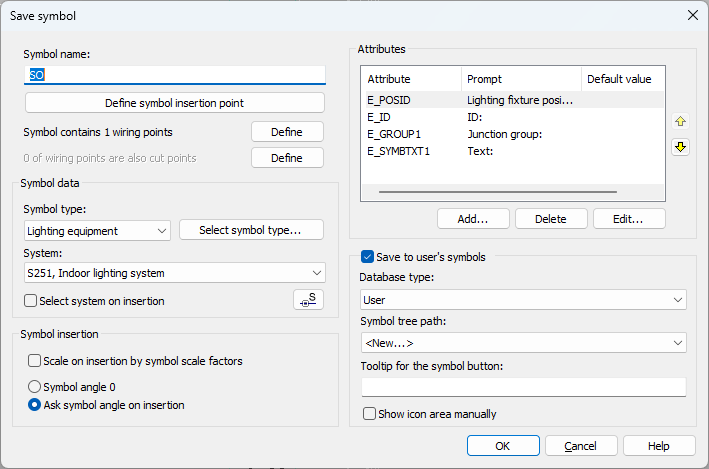
Indicate symbol's insertion point. The Save symbol dialog opens.
-
Define symbol data:
- Symbol name – Enter the name of the symbol to be saved. The function adds SO by default but you can name the symbols any way you want.
- Define symbol insertion point – Click to define the insertion point.
- Symbol contains X wiring points –
-
Click Define.
-
Indicate the wiring point to which you want to draw the wiring.
-
Indicate the wiring point's number attribute i.e. the attribute from which to read the connection information.
- X of wiring points are also cut points –
- Symbol
data
- Symbol type is important for the functions to recognize the symbol to certain electric symbol.
- With Select symbol type, you can select several subtypes.
- From the System drop-down menu, select the system the symbol belongs to. If you want to define the system when inserting the symbol, select Select system on insertion. Alternatively, take the system from another element by clicking the
 (Pick system from drawing) button.
- Symbol insertion
- Scale on insertion by symbol scale factors – The symbol is scalable i.e. it gets elevation based on the symbol scale factors in connection with insertion. Otherwise, the symbol is of the real size (linear light, for example).
- Symbol angle can be 0 or you can indicate it.
- Attributes – You can add, delete and edit the attributes. Every symbol needs at least the E_ID attribute (ID).
-
Add – Select the desired attribute and insert default value if needed. Click OK and indicate the insertion point.
-
Delete – Remove an attribute.
-
Edit – Edit attribute properties. You can edit the order of attributes in the symbol with the arrow buttons.
- Save to user's symbols
- Database type – Select the type of the database: User or Shared.
- Symbol tree path – Select the desired symbol tree folder from the drop-down menu, or create a new one by selecting New. The folders can be managed in the Symbols window. The symbols will also be saved to the default icon menu based on the symbol type.
- Tooltip for the symbol button – Define the tooltip shown when hovering over the symbol button.
- Show icon area manually – Outline the area you want to show in the symbol button.
 Show/hide details
Do the following:
-
Click OK.
Edit attribute properties
In the Save symbol dialog, click Edit to open the Attribute properties dialog.

-
Pin – Define the running number for pin attributes.
-
Part number – Compiled symbols require a part number. If different symbols are used for different device occurrences and the symbols have the same attributes while they mean different things, you have to define a part number, which separates the pins from each other.
An example of a compiled contactor symbol
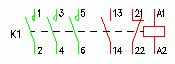
E_PINA001[112], Value: 1, Part number: 112
E_PINB001[112], Value: 2, Part number: 112
E_PINA001[114], Value: 3, Part number: 114
E_PINB001[114], Value: 4, Part number: 114
E_PINA001[116], Value: 5, Part number: 116
E_PINB001[116], Value: 6, Part number: 116
E_PINA001[202], Value: 13, Part number: 202
E_PINB001[202], Value: 14, Part number: 202
E_PINA001[201], Value: 21, Part number: 201
E_PINB001[201], Value: 22, Part number: 201
E_PINA001[101], Value: A1, Part number: 101
E_PINB001[101], Value: A2, Part number: 101
-
Attribute name – The name is generated from the attribute, pin number and part number.
-
Prompt – Define the prompt/description shown when using the symbol.
-
Default value – Define a default value for the attribute. Alternatively, you can leave this blank and select to define the attribute value on symbol insertion.
-
Ask attribute value on symbol insertion – Select this if you want the application to ask for the attribute value when you insert the symbol. If you defined the default value, that will be used.
-
Attribute visible – Select this if you want the attribute to be shown in the drawing.
-
Reposition attribute (available when editing) – Select this if you want to reposition the attribute you are editing.
-
Alignment and Vertical alignment – Define the horizontal and vertical alignment for the attribute.
-
Appearance – Define the size, angle (in degrees) and color of the attribute. The angle is typically 0, for vertically readable attributes 90 or 270. Other free angles are also supported.