Logistics spaces
The purpose of the logistics spaces hierarchy tree is to be able to publish logistics containment and an optional phase value for each model object.
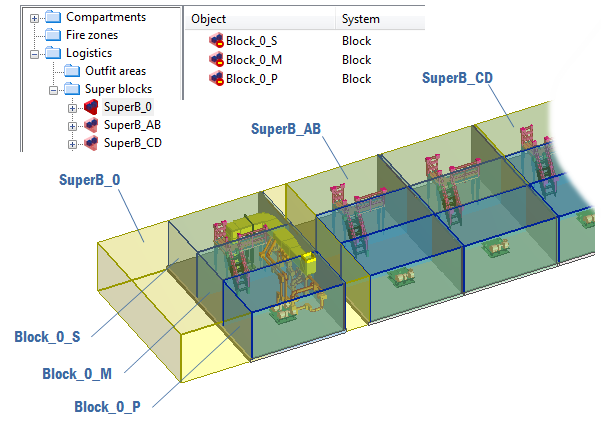
Logistics spaces, which are used to model relationships between model objects and various logistics phases, can form a more complex hierarchy.
-
There may be several levels (e.g. outfit area || superblock/block) to which model objects can be assigned.
-
The goal is to automatically construct this tree as much as possible through spatial containment and rules. When containment is computed from a spatial location, the order of evaluation follows the order of branches in the tree. In this case, contained objects receive a default phase value. In the logistics hierarchy of our example, blocks fall under superblocks, and outfit areas are at the same level as superblocks. If a model object is not entirely within any block but is completely within a superblock and simultaneously within an outfit area, the containment of this model object is considered the outfit area. This is because the outfit area branch precedes the superblock branch in the logistics hierarchy.
-
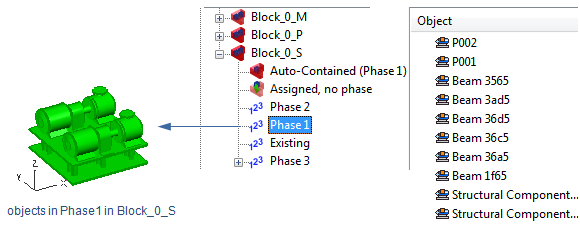
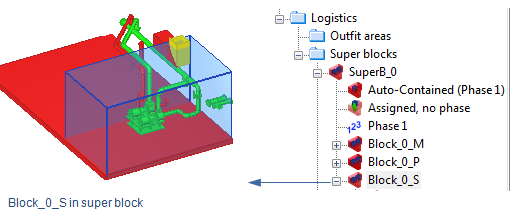
Containment can also be specified explicitly through selection, creating an association that does not necessarily need to be computed from a spatial location. The same explicit selection and association can also specify the non-spatial phase value. The phase value attribute is associated with the logistics hierarchy, eliminating the need for any separate attribute to specify this.
-
Phase values that are used in logistics hierarchies are defined as the value set of a COS attribute that is associated with the logistics hierarchy.